

A Burning Smell from the Window AC Led Rahul Singh to the Best AC Repair Service in Aligarh
Window AC service Aligarh
There are sounds a house makes that you learn to ignore.
The creak of a particular floorboard. The soft hum of the refrigerator cycling at night. The click of the water heater at five in the morning. After a few years in any home, these become invisible — part of the background noise of daily life.
A burning smell is never part of that background.
Rahul Singh switched on his window AC at nine-thirty on a Monday morning. It was the second week of June in Aligarh, and the temperature had already crossed thirty-eight degrees before ten o'clock. His small home office on the first floor had been heating up since sunrise, and he had held off on switching the AC on while he finished a call.
The unit came on with its usual shudder. The fan started. The compressor kicked in a few seconds later.
Then, within two minutes, Rahul noticed it.
A faint burning smell. Not smoke. Not a visible problem. Just a smell — warm, electrical, slightly acrid — coming unmistakably from the direction of the window AC unit.
He did not wait to see if it would go away.
He crossed the room, switched the unit off from the remote, then pressed the power switch on the unit itself to be sure. He opened the window on the other side of the room to let air move through, stood back, and thought about what to do next.
He searched immediately for Window AC service Aligarh specifically a service that could come the same day, because a burning smell from an electrical appliance in a first-floor room was not a problem he was willing to leave overnight.
Why a Burning Smell from a Window AC Is Never a Small Thing
Before he called anyone, Rahul spent ten minutes reading about what causes burning smells from window AC units. What he found made him glad he had switched it off immediately.
A burning smell from an AC unit can come from several sources, and none of them are self-resolving:
The most common cause is accumulated dust on the heating coils or fan motor that burns off when the unit is first used after a long gap. This type of smell is usually brief, mild, and dissipates quickly. It still indicates that the unit needs a thorough internal cleaning, but it is the least alarming of the causes.
More serious is a failing fan motor. When the motor windings begin to degrade — from age, overheating, or electrical stress — the insulation around the copper windings starts to break down. This produces a persistent electrical burning smell that grows more noticeable over time. Running the unit in this condition accelerates the failure and risks a short circuit.
A failing capacitor produces a similar smell and can cause the fan to run slowly or erratically before failing completely. In some cases, a capacitor that has failed in a shorted condition continues to carry current and heat up — which is why switching the unit off is the correct immediate response.
Wiring faults — loose connections, damaged insulation, or a failing thermostat — can also produce a burning smell and carry a higher safety risk if the unit continues to run.
Rahul had no way of knowing from the smell alone which of these applied to his unit. That was exactly why he needed a qualified technician — and why he needed one that day.
The Call to the Best Window AC Service in Aligarh
Suresh answered.
Rahul described the situation precisely: window AC unit, switched on after several days off, burning smell within two minutes of operation, unit now switched off. He mentioned the unit's approximate age — around five years — and that it had not been serviced since the previous summer.
Suresh: You made the right call switching it off immediately. A burning smell that appears within minutes of start-up usually points to a motor or capacitor issue rather than dust burnoff, especially in a unit that has been running for five summers.
Rahul: What is the difference? Why does the age matter?
Suresh: The run capacitor in a window AC typically has a service life of four to six years under heavy summer use. After that point, the capacitor's internal chemistry degrades — it can no longer provide the correct starting current to the fan motor. When a motor runs without adequate current, it compensates by drawing more amperage through its windings, which generates heat and produces exactly the kind of smell you noticed. If the motor windings themselves have started to break down, you get the same result but with faster progression.
Rahul: Is this dangerous to leave?
Suresh: Yes. A unit with a failing capacitor or degrading motor windings should not be operated until the fault is identified and corrected. I can come this afternoon.
Rahul confirmed the address and time.
Suresh Arrives Inspection Before Any Work Begins
Suresh arrived at two-fifteen that afternoon.
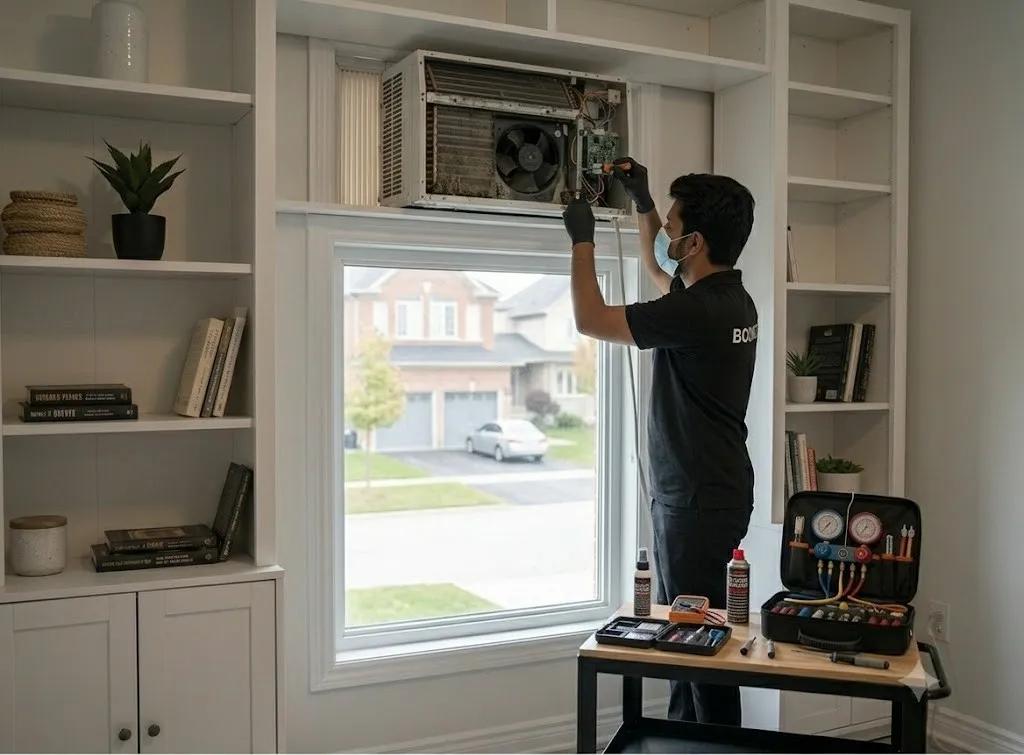
He went directly to the window AC unit and began the inspection without rushing. He asked Rahul to switch the unit on briefly — just long enough for him to observe the start up sequence and listen to the compressor and fan simultaneously.
The smell returned within ninety seconds.
Suresh switched the unit off himself, noted something, and opened his toolkit.
Suresh: The smell is electrical not dust. The motor is trying to start but the current draw is inconsistent, which tells me the capacitor is failing. I can also hear the fan speed is slightly lower than it should be at startup, which confirms the motor is not receiving full starting torque.
Rahul: So it is the capacitor?
Suresh: Almost certainly. But I will test the motor windings as well, because a capacitor that has been failing for a while can stress the motor beyond its normal tolerance. If the windings have begun to break down, a capacitor replacement alone will not fully solve the problem.
He removed the front cover of the unit and used a multimeter to test the capacitor's capacitance value. The reading was less than forty percent of the rated value.
He then tested the fan motor windings.
Suresh: The capacitor has failed significantly — that is the primary cause of what you smelled. The motor windings are showing slightly elevated resistance but are still within a workable range. I would recommend replacing the capacitor today and cleaning the motor and coils thoroughly. If the motor's resistance continues to climb over the next season, it will need replacement — but today it does not need to come out.
He showed Rahul the multimeter readings and the rating printed on the old capacitor so the comparison was visible.
Rahul approved the repair.
The Repair Done Properly on the Same Visit
Suresh completed the full repair in just under two hours, working through every step that a responsible Window AC service Aligarh call should cover:
Full power isolation — Unit disconnected from the mains before any internal access
Capacitor discharge — Old capacitor safely discharged before removal
Capacitor replacement — New component installed with matching voltage and capacitance rating, connections verified against the original wiring
Internal cleaning — Accumulated dust removed from the fan motor housing, condenser coils, evaporator coils, and filter assembly. Five years of Aligarh summer dust had built up significantly on the coil fins, which was contributing to the motor running hotter than it should
Coil fin straightening — Several bent coil fins were carefully straightened to restore proper airflow across the coils
When the unit restarted after the repair, the smell was completely gone.
The fan ran at full speed from the first second of operation. The room temperature began dropping within five minutes.
Rahul: That is what it is supposed to sound like. I had forgotten — it has been running slow and slightly noisily for months. I just assumed that was normal for an older unit.
Suresh: It is common to adjust gradually to a unit's declining performance without realizing how much it has changed. A clean unit with a functioning capacitor draws less current, runs cooler, and cools the room faster. You will likely see it in the electricity bill as well.
What the Visit Taught Rahul About Window AC Maintenance
After Suresh left, Rahul sat in the now-comfortable office and thought about what had nearly happened.
The unit had been declining for months. The slow fan, the longer cooling time, the slightly higher electricity bill he had attributed to general price increases all of these had been symptoms of a capacitor that was quietly failing through the entire previous season.
If he had not switched the unit off when the smell appeared — if he had opened a window and hoped it would go away the motor windings would have continued to degrade under the stress of inadequate current. Within days or weeks, the motor would have failed completely. In a worst-case scenario, a short circuit in a unit left running unattended carries fire risk.
The smell was not an inconvenience. It was a warning that worked exactly as it was supposed to.
He wrote the service contact into his phone under a permanent label and set a calendar reminder for the following March: Window AC service before summer.
A window AC that is showing any of these signs is already working harder than it should. Continued operation accelerates the failure and increases the cost of eventual repair.
Question: Is it safe to keep running a window AC that smells like burning?
Answer: No. Switch the unit off immediately and leave it off until a technician has inspected it. A burning smell indicates that something inside the unit is overheating — either because of a failing component drawing excess current or because of electrical insulation breaking down. Running the unit in this condition risks further component damage and, in cases of wiring fault, creates a fire hazard.
Question: How often should a window AC be serviced in Aligarh?
Answer: In Aligarh's climate, where window ACs typically run at high load for five to six months per year, a full service before the summer season begins — ideally in March or April — is the minimum recommended maintenance. Units older than three to four years benefit from capacitor testing as part of that service, since capacitor degradation is the most common cause of mid-season failure. Units used in dusty environments should have the filter and coil cleaned more frequently.
Question: Can window AC electrical faults be repaired the same day?
Answer: In most cases, yes. Capacitor replacement — the most frequent electrical fault in window ACs — requires a component that experienced technicians carry in their service kits for common ratings. Fan motor replacement takes slightly longer but is still typically completable within the same visit if the correct motor is available. More complex wiring faults may require parts to be sourced, but a same-day diagnosis is always possible and is the critical first step regardless.
Conclusion
A burning smell coming from your AC is never a warning sign to ignore. Whether it is caused by overheating electrical components, damaged wiring, a failing motor, or excessive dust build-up, the problem can quickly worsen if left unchecked. If your window AC is producing unusual odors, running with a slow fan, shutting down unexpectedly, or showing any other signs of trouble, it is important to act immediately. Delaying repairs can lead to more extensive damage, higher repair costs, and even potential safety risks. Don't wait for your AC to stop working completely schedule professional AC repair in Aligarh at the first sign of trouble and restore your comfort before the unit makes the decision for you.
Ready to Book Your AC Repair Today?
Do not let a broken AC ruin your day. Reach out right now and get fast, reliable service at your doorstep.
📞Call us: +91 843 991 1779
🌐 Visit our website: https://myboomzo.com/